Bron-Yr-Aur (which means golden hill in Welsh, one of the Celtic languages of the British Isles; interestingly enough, just as a linguistic side note, aur means gold in my native language as well, more specifically Romanian) is an 18th century remote and rustic stone cottage situated in the southern part of Snowdonia National Park (or Eryri National Park) in Wales, among the hills around the beautiful market town of Macynlleth, North Wales. It is best remembered by longtime Led Zeppelin fans as the creative retreat where legendary rock musicians singer Robert Plant and guitarist Jimmy Page composed most of the songs for Led Zeppelin III, the band’s third studio album released in 1970, as well as, to a lesser extent, several songs for the band’s sixth studio album entitled Physical Graffiti which was released in 1975. Up until the point of retreating here, the band experienced the tremendous commercial success of their second studio album, Led Zeppelin II (1969), which came by in a relatively short amount of time (topping the US charts at number 1), with fans looking forward to their musical evolution.
Back in 1970, the cabin had no running water or electricity, but this did not prevent Robert Plant and Jimmy Page to compose some of the most catchy and beautiful folk-tinted songs in rock music history. The nearby nature served as a wonderful inspiration for the two legendary British rock musicians who took their guitars there, played a bit on them, and then got to writing new songs. This way, the two got to know each other better as well.
Three notable Led Zeppelin III songs which were composed at Bron-Yr-Aur cottage are Friends, That’s The Way, and, naturally, Bron-Y-Aur Stomp. In addition, other songs for other studio albums by the band were also initially developed there, more specifically Poor Tom for Led Zeppelin IV (1971), Over The Hills And Far Away and The Crunge for Houses Of The Holy (1973) as well as The Rover, Down By The Seaside, and Bron-Yr-Aur for Physical Graffiti (1975).
Nowadays, the cottage is a private property, more specifically an eco-farm or micro-farm which generates its own energy from renewable resources (i.e. solar, wind, and hydro power) and, wait for it (there’s more to it, of course)… its owner also intends to turn into a micronation! Yes, you read that right, a micronation (currently, it is a self-declared micronation). It even has its own website! How cool is that?! Prospective citizens can hypothetically acquire the citizenship if the want it in exchange for a certain amount of money. The fee is published on the cottage’s website and the citizenship lasts for one person’s entire lifetime.
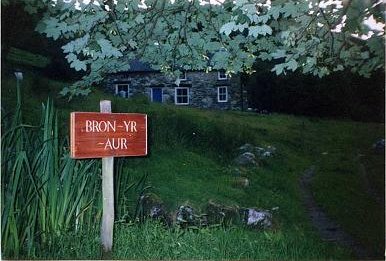
The picturesque Bron-Yr-Aur stone cottage dating back to the 18th century from Snowdonia National Park, Wales, Great Britain (as seen in April, 2007). Image source: Wikimedia Commons
Below you can listen to a remastered version of Bron-Yr-Aur Stomp:
On a personal note, I must mention the fact that I perceive Bron-Yr-Aur one of the most touching and beautiful musical gems in the entire discography of Led Zeppelin. And I also have a story of mine on it. Back when I was still an international student at Aalborg University (AAU) living in Aalborg, North Jutland, Denmark, I was invited at the place of a former university groupmate of mine (we studied Medialogy for some time back in late 2017) in the smaller yet historically very significant and picturesque satellite town of Nørresundby for an amateur rehearsal session (that was during the autumn of 2018). At that time, I had a Harley Benton acoustic guitar and an Alesis keyboard, both purchased from Thomann for very good, affordable prices I must say (and I still have both of these musical instruments to this day, believe it or not; by the way, thank you very much, Thomann).
We rehearsed a bit at his place and improvised some demoes (one of them ended up being called ‘Shadows in the Night’, an idea I think I came up with, if I recall correctly; this song was never professionally released though) while enjoying some really good gløgg (thank you so much for your hospitality once again, I love gløgg, I will always do). We also discussed about classic rock a bit and I couldn’t help but bring out the subject of the legendary Bron-yr-Aur cottage in Wales, showing him a photograph of it as seen while the surrounding landscape was on the verge of autumn (namely this one via Wikimedia Commons). I still recall his reaction. ‘Spooky…’, he said. We both laughed a bit afterwards, but I didn’t consider (nor do I consider now or ever in the future for that matter) the Bron-yr-Aur cottage as a spooky place. Quite the contrary. I mean, it’s obviously not Boleskine House in Scotland, heh. That indeed was kind of a spooky and allegedly haunted place in the band’s history.
Documentation sources and external links:
- Led Zeppelin at Bron-Yr-Aur on www.bbc.co.uk
- Snowdonia cottage made famous by Led Zeppelin opens its grounds to campers on www.dailypost.co.uk
- Bron-Yr-Aur on www.wikipedia.org (in English)
- Bron-Yr-Aur on www.wikipedia.org (in Norwegian Bokmål)