What some might not know is the fact that after the untimely and very unfortunate death of American lead vocalist and poet Jim Morrison, The Doors went on, continuing to perform as a trio until 1973. As such, the band consisted then of the surviving members Ray Manzarek (keyboards), Robby Krieger (guitar), and John Densmore (drums and percussion). Even though the band’s musical chemistry wasn’t the same (and it couldn’t have been the same without their legendary singer), the trio released two pretty good records, more specifically Other Voices in 1971 and Full Circle in 1972. Ray Manzarek and Robby Krieger both performed vocals on various songs on the two aforementioned LPs. In addition, Robby Krieger also played on harmonica on Full Circle. Although the group received a mixture of relatively good critical acclaim and commercial success with these two studio albums, the trio officially disbanded in 1973 only to reunite in 1978 for the production of the posthumous studio album An American Prayer which includes Jim Morrison’s surreal poetry as well. The last Doors single to chart was ‘The Mosquito’, a funny vocal-instrumental composition with Robby Krieger on lead vocals.
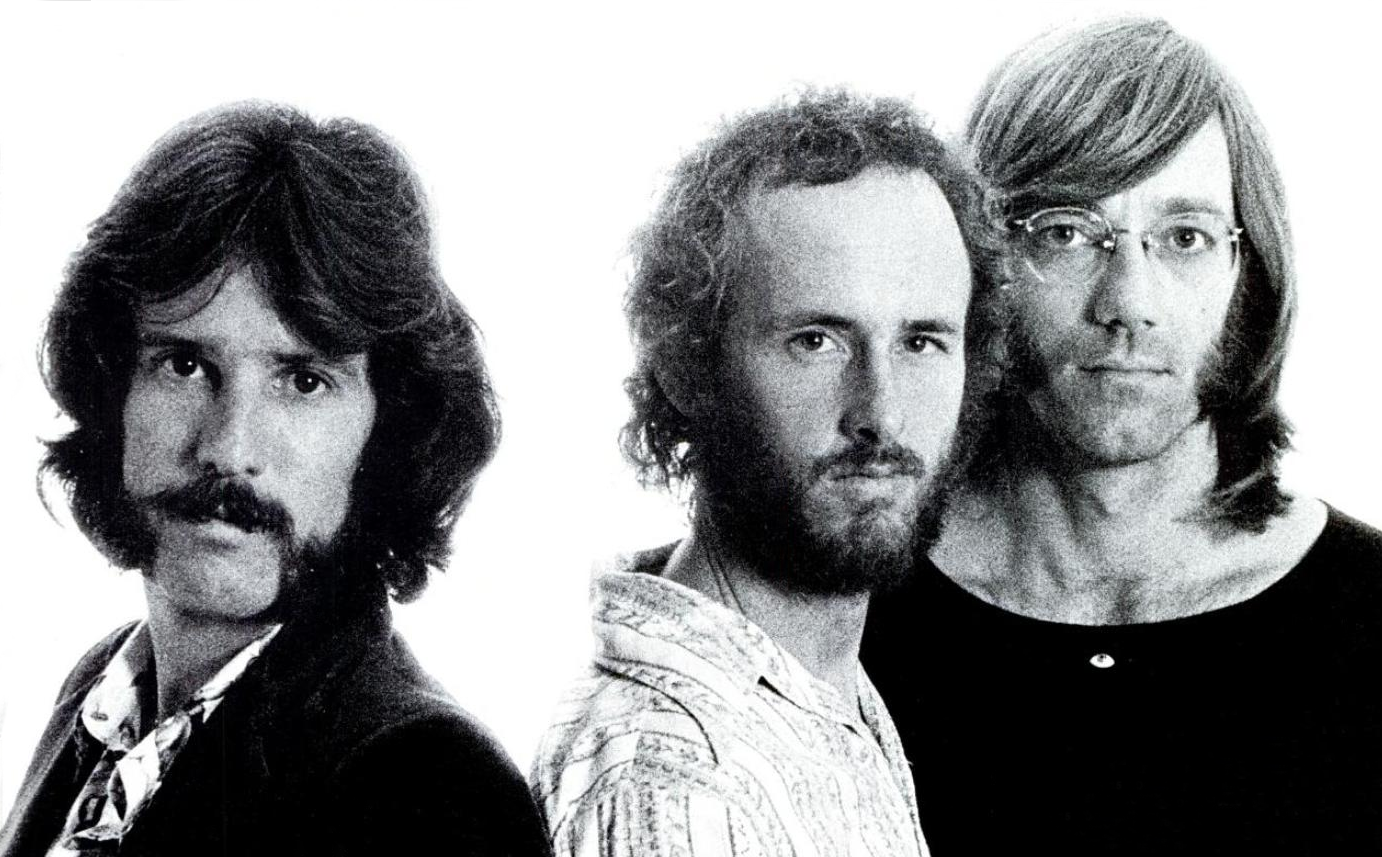
The Doors in 1971, after the untimely and very unfortunate death of their legendary lead vocalist and poet Jim Morrison which took place earlier that year. From left to right: John Densmore (drums and percussion), Robby Krieger (guitar, co-lead vocals, harmonica), and Ray Manzarek (keyboard and co-lead vocals). This photograph was used as a trade ad by Elektra Records (their label) for their first post-Morrison studio album entitled Other Voices which was also released in 1971. Image source: Wikimedia Commons
The frontal cover artwork of Other Voices depicts the three surviving members of the band while Full Circle has a more surreal one, depicting what I personally perceive as a reference towards the circle of reincarnation in a very dreamy manner. There is also a sphinx in the background of the frontal cover artwork of the said studio album (which might be Ray Manzarek’s interest in the civilisation, culture, mysticism, mythology, and spirituality of ancient Egypt, as he it can be clearly observed on his studio album entitled The Golden Scarab which was recorded in 1973 and released in 1974).
Below you can listen to some of my most favourite songs from the two post-Morrison records which are definitely worth listening to. In my humble opinion, if some listeners cling only to the hits then they are sort of missing out on the entire catalogue of the band which includes many relatively lesser known musical gems such as those from these two great studio albums, if without legendary lead vocalist and poet Morrison. The post-Morrison saga of the three surviving Doors members started off with the eye of the sun (before the world had begun):
Documentation sources and external links:
- The Doors on www.wikipedia.org (in English)
- The Doors on www.britannica.com (the online version of Encyclopædia Britannica)
- Other Voices (The Doors) on www.wikipedia.org (in English)
- Full Circle on www.wikipedia.org (in English)
- détente on www.britannica.com (the online version of Encyclopædia Britannica)