Waiting for the Sun is the title of the third studio album (or LP) of the American classic rock, psychedelic rock, and blues rock band The Doors which was released in 1968 through Elektra Records. It was recorded between 1967 and 1968 for the most part at the TTG Studios in Los Angeles, California. It achieved notable commercial and mixed critical success, being the band’s only discographical studio material to reach the first position on the Billboard 200 charts (throughout a period of four weeks). The album equally included the band’s second number one single in the United States, namely the touching and beautiful song ‘Hello, I Love You’ (the second single released from the album). The album had quite a noteworthy impact in the United Kingdom as well, charting at number 16 in the British charts. The album’s first single entitled ‘The Unknown Soldier’ reached number 39 on the Billboard Hot 100.
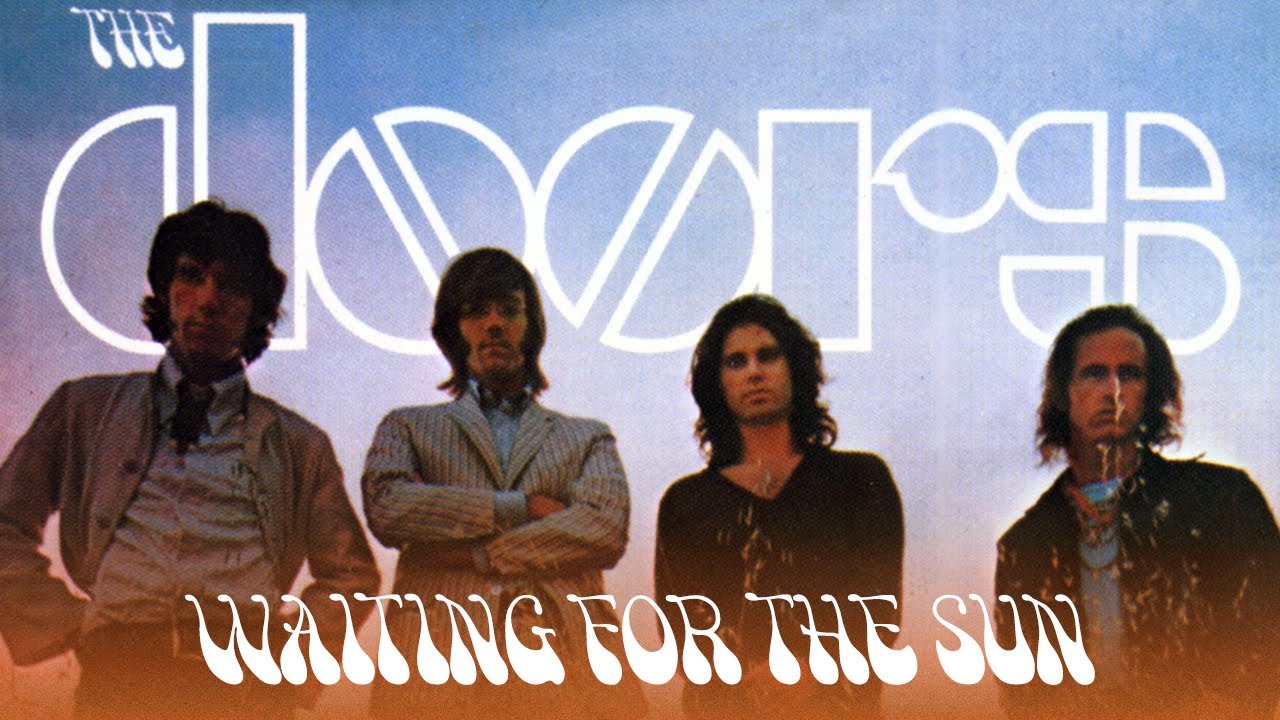
The frontal cover artwork of the third studio album by The Doors, Waiting for the Sun, released on 3 July, 1968. From left to right, John Densmore (drums), Raymond ‘Ray’ Daniel Manzarek (keyboards), Jim Morrison (poetry and lead vocals), and Robby Krieger (electric guitar). Image source: www.youtube.com
During the recording process of the album, the band went through what the group’s drummer John Densmore described as the ‘third album syndrome’, meaning they struggled a bit to composed new material after two previously successful records, more specifically their self-titled studio album which was released in 1967 and Strange Days which was also released during the same year. The recording sessions of the album were quite challenging given lead singer Jim Morrison‘s drinking issues.
In terms of critical reception, Waiting for the Sun scored 3.5 out 5 stars on AllMusic, 4 stars on American Songwriter, 4 stars on Classic Rock, 3.5 out of 5 stars on MusicHound Rock, a mixed review by Rolling Stone magazine, 3.5 out of 5 stars by the Rolling Stone Album Guide, 4 out of 5 stars by Slant Magazine, and 3 out of 5 stars by Virgin Encyclopedia of Popular Music.
Waiting for the Sun is one of the most important psychedelic and classic rock studio albums of the late 1960s as well as a fine example of the American counterculture of the respective decade in musical regards. Additionally, it is one of the most beautiful classic rock studio albums that a true rock fan can listen to especially during the summer (but not only, of course). The tracklist of the record (consisting of two sides; side one comprising the first six songs while side two the remainder) is as follows:
- Hello, I Love You
- Love Street
- Not to Touch the Earth
- Summer’s Almost Gone
- Wintertime Love
- The Unknown Soldier
- Spanish Caravan (flamenco-influence or inspired)
- My Wild Love
- We Could Be So Good Together
- Yes, the River Knows
- Five to One
The 40th and 50th anniversary editions of the album also included several bonus tracks. The band’s recording personnel was as follows:
- Jim Douglas Morrison – poetry and vocals
- Raymond ‘Ray’ Daniel Manzarek – keyboards
- Robby Krieger – electric guitar
- John Densmore – drums
There were also three session musicians involved in the recording sessions as bassists, more specifically Douglas Lubahn (who provided electric bass guitar on the song ‘Spanish Caravan’), Kerry Magness (who provided electric bass guitar on the song ‘The Unknown Soldier’), and Leroy Vinnegar (who provided acoustic bass on the song ‘Spanish Caravan’). Regarding the technical personnel, Paul A. Rothchild was in charge of the production of the album, Bruce Botnick was in charge of engineering, William S. Harvey took care of the art direction and design, Paul Ferrara did the front cover photograph, and Guy Webster did the back cover photograph.
The album’s lyrical themes include romance, hope in times of war (i.e. as expressed in the lyrics of the song ‘The Unknown Soldier’), and differences between generations (i.e. as expressed in the lyrics of the song ‘Five to One’). Below you can listen to the entire studio album embedded song by song via YouTube:
Thank you very much for your time, attention, and readership! All the best and rock on! 🙂 🤘
Documentation source:
- The album’s page on www.wikipedia.org (in English)
- The album’s page on www.discogs.com
- The album’s page on www.spotify.com
- A review of the album published in New Musical Express and available on the band’s official website on www.thedoors.com (the review is a bit inaccurate or flawed, but, still, it is relevant enough as a musical historical document so to put it)
- The entire playlist of the album on www.youtube.com