
During the 1980s, the British gothic rock band The Cult were one of the best and most popular rock bands of the decade. Their initial success came with their second studio album entitled Love which was released in 1985. In this brief article, I am analysing the esoteric symbolism of this beautiful studio album which I have been listening to since my early teenage onwards. Stylistically, the entire studio album was influenced or inspired by various forms of spirituality, ranging from Eastern spirituality (i.e. Buddhism or Hinduism, most notably on the song Nirvana) to ancient Egyptian mysticism (which I always found fascinating). The frontal and back covers of the studio album feature several ancient Egyptian-like esoteric symbols which have been intriguing me for quite some time. Two of them are actually ancient Egyptian symbols for certain, one known as Ba (representing the soul of mortal man in Ancient Egypt, namely the spiritual essence or personality) and the other one a scarab.
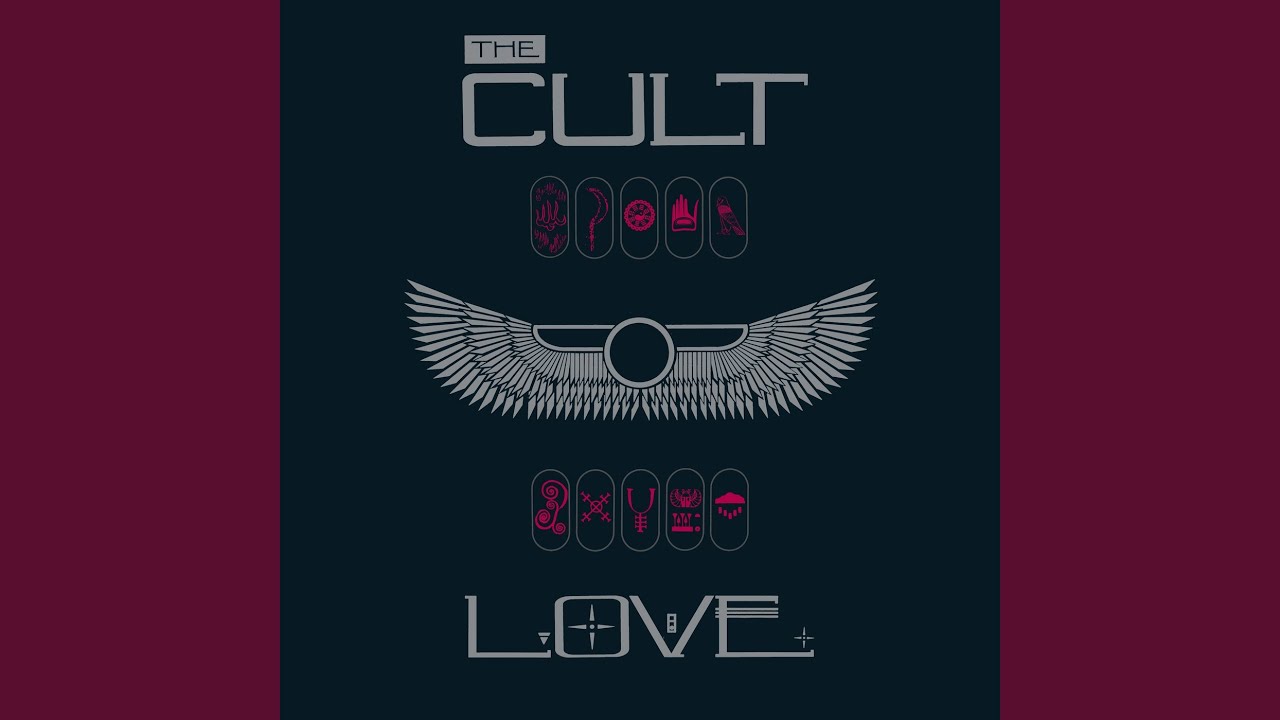
The frontal cover artwork of the studio album Love by The Cult which was released in 1985. Image source: YouTube
On the back cover artwork, after the entire tracklist, there are 10 rather esoteric symbols or sigils which are both beautiful and puzzling at the same time. These 10 symbols or sigils are initially depicted on the frontal cover artwork (in this regard, I really like this mirroring, so to put it). However, the frontal cover artwork separates them in two rows, each containing 5 symbols or sigils separated by feathered wings in ancient Egyptian style (possibly associated with the beautiful ancient Egyptian goddess Isis, therefore denoting divine protection, healing, the breath of life, maternal love, and the wonderful and enchanting divine feminine energy in general). The mystery behind their actual meaning intrigued me to such an extent that I decided to rightfully do a little bit of research on the matter. As per my research so far, each symbol corresponds to one of the songs on the record (as there are 10 in total). So far, so good… but that’s not quite enough. Let’s have a closer look at them, shall we? The following YouTube video by AudioMover goes in depth with respect to the meaning of each and every constituent esoteric symbol of this fascinating LP with very catchy songs.
Spoiler alert: the main themes explored by the songs of this studio album are love (naturally, the proof is in the pudding, after all), sensuality, the passage of time, and mortality.
P.S. One of the symbols of the album looks a bit like a crossover or combination between the wheel of karma with the yin-yang symbol in it (which denotes the duality of this world). Thank you very much for your time, attention, and readership! All the best and rock on!